
Seeing such a question: “The bolt that is loosened first in bolt connection is actually less likely to break.” Do you know why?
First, it is necessary to clarify the degree of looseness and the type of load that the bolt assembly is subjected to, in order to determine whether the loosened bolt will break first. This is discussed under three scenarios.
1. If only subjected to static load, the bolt that is loosened first will not break first. If a bolt is loosened, it indicates that the pre-tightening force has decreased or is zero. The smaller the pre-tightening force, the lower the combined working stress of the bolt under external load. Naturally, the bolt with the minimum working stress will not break first under static load conditions.
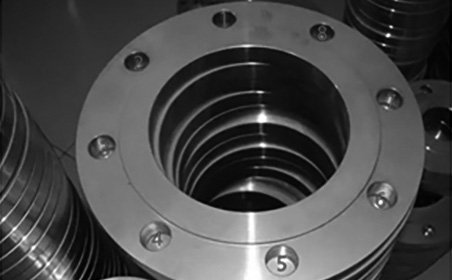
Now, taking the bolt connection in flange connection as an example, let’s see what would happen to the force on the bolt if one of the bolts becomes loose. The flange is connected by 8 M16 Grade 10.9 bolts, and the bolt numbers are shown in the figure below:
Under normal circumstances, bolts are applied with the same pre-tightening force. Assuming the pre-tightening force of the bolt is 98KN, if one bolt becomes loose, it indicates that the pre-tightening force has decreased or there is no pre-tightening force left. Here, the pre-tightening force of bolt 1 is set to 30KN, which is 68KN less than that of the other bolts. Let’s see how the stress on the bolts differs when the flange bears a tensile force of 600KN;
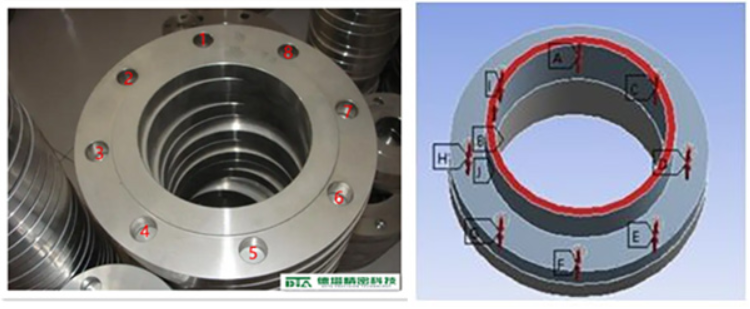
The stress conditions of the bolt are shown in the table below:

According to the analysis results, the relaxation of bolt 1 has altered the force distribution of all bolts. The tension borne by the relaxed bolt has decreased, while the tension borne by the two bolts (bolt 2 and bolt 8) adjacent to the relaxed bolt has increased. Higher tension means greater internal stress. If the load continues to increase, these two bolts will break first.
2. If the bolt group is subjected to fatigue loads and the bolts are completely loosened (i.e., there is no pre-tightening force), even under external loads, the bolts will not be stressed. The adjacent bolts will bear the force they should bear, so the loosened bolts will not break first, and the adjacent bolts may break first.
Using the flange connection as an example, if one bolt is completely loosened, meaning its preload is zero, the preload of the other bolts remains at 98KN.

From the above results, it can be seen that when a fully relaxed bolt is subjected to an external load in a flange connection, it does not bear any tensile force, meaning the tensile force is zero.
When the flange bears an alternating load ranging from 0 to 600KN, the tensile force variation range of each bolt is:

Based on the fatigue characteristics of bolts, it can be inferred that the greater the range of stress variation in a bolt, the sooner it will experience fatigue fracture, and the shorter its fatigue life will be. Therefore, the two bolts immediately adjacent to a fully relaxed bolt on both sides will experience fatigue fracture first, while the fully relaxed bolt itself will not fracture.
If the bolt’s pre-tightening force is reduced, its combined stress range will increase under fatigue loading, leading to a reduction in fatigue life compared to the design life, and possibly resulting in fatigue fracture occurring earlier.
Assuming the pre-tightening force of the bolts is 98KN, if one bolt is loose, it indicates that the pre-tightening force has decreased, or there is no pre-tightening force left. Here, the pre-tightening force of bolt 1 is set to 30KN, which is 68KN less than that of the other bolts. When the flange is subjected to an alternating tensile force ranging from 0 to 600KN, the force and tensile force variation range of the bolts are calculated as shown in the following table:
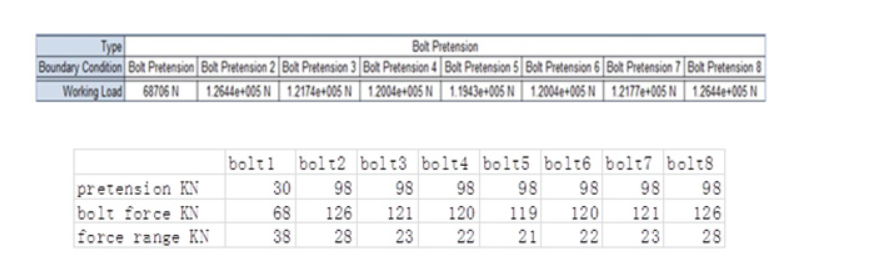
From the calculation results in the table above, it can be observed that the force variation range of the bolt that is not fully relaxed and its two adjacent bolts is relatively large. Therefore, the bolt that is not fully relaxed and its two adjacent bolts on both sides will undergo fatigue fracture first.
From the above three points of analysis, we can understand why, in bolt connections, the bolt that is loosened first is less likely to break. This is because the loosened bolt will bear significantly less force, which in turn increases the force on the adjacent bolt. As a result, other bolts may fatigue and break due to the high force, whereas the loosened bolt will break later.